

One of the hardest things in crypto isn’t finding an entry — it’s realizing when the “best” entries are already behind you.
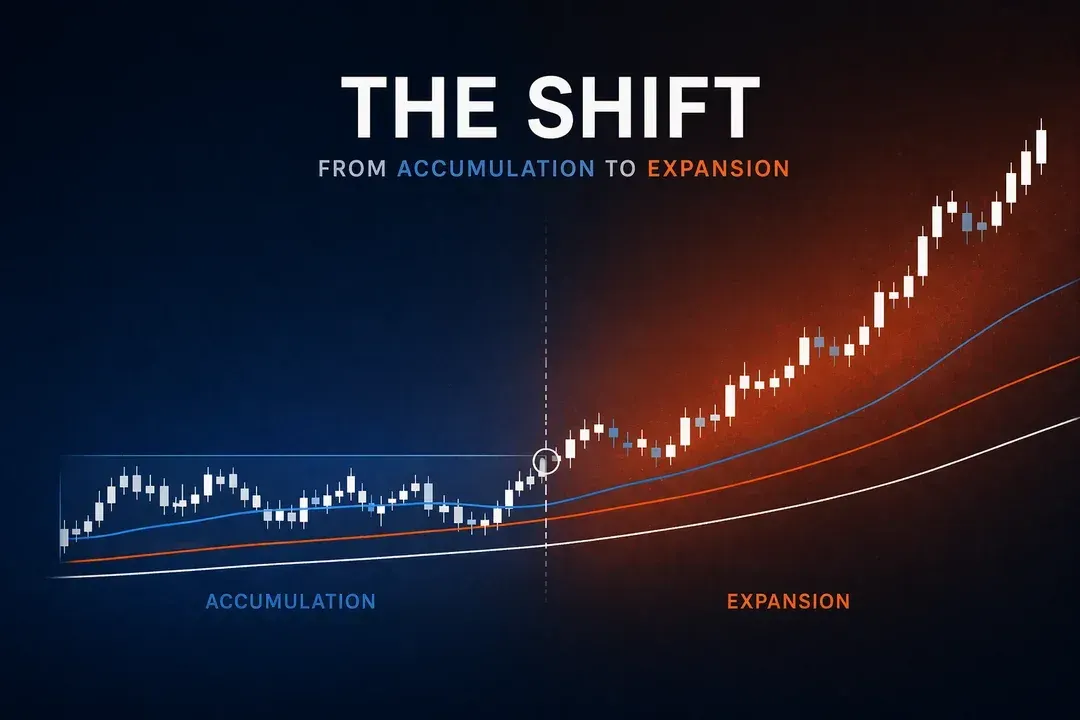
Markets don’t flip from accumulation to expansion in a clean, obvious way. There’s no single breakout candle that confirms the shift. Instead, it’s a gradual transition, and you start to notice it when multiple things begin to change at the same time.
Right now, we’re seeing early signs of exactly that.
For weeks or even months, the market may have been dominated by short waves — lower highs, failed breakouts, constant rejection at resistance. But at some point, that behavior starts to weaken. Pullbacks lose momentum, downside follow-through disappears, and what used to be clean bearish continuation suddenly turns into chop or even immediate reversals.
That’s usually the first subtle signal: “the market stops behaving bearishly.”
At the same time, momentum begins to shift. RSI levels that previously marked local tops — typically around 70 — start getting pushed higher. Instead of rejecting, the market accepts these levels and continues. You’ll often see RSI move into the 80s or even approach 90 during strong expansions.
This is where many get it wrong. “Overbought” doesn’t mean the move is over — in strong trends, it often means the opposite. It signals that demand is persistent and aggressive enough to keep price elevated.
Structure tells a similar story. Resistance levels that previously caused repeated rejections start breaking cleanly. More importantly, they don’t act as resistance anymore. Price comes back, retests, and holds. What used to be a ceiling becomes a floor.
That’s not just a breakout — that’s acceptance.
A very reliable way to track this transition is through moving averages, especially on higher timeframes. The 50-day and 200-day moving averages are widely used as trend filters, but in crypto — and particularly with Bitcoin — the 50-week and 200-week moving averages have historically played an even more important role.
The 200-week moving average has repeatedly acted as a long-term support zone. During the 2018 bear market, Bitcoin bottomed very close to this level. In March 2020, during the Covid liquidity crash, price briefly wicked below it before reclaiming it quickly — marking a major turning point. The same zone was revisited again during the 2022 cycle low, where price once more interacted with the 200-week MA before forming a base.
The 50-week moving average, on the other hand, often acts as a trend confirmation level. Once price reclaims it and holds above, it frequently transitions from resistance into support, signaling that market structure is shifting toward expansion.
What makes the current environment interesting is that multiple of these signals can start aligning. Momentum stays elevated, resistance breaks and holds, moving averages begin to flip, and short setups lose their edge.
At the same time, macro conditions can quietly shift in the background. Markets don’t need perfect conditions — they just need less uncertainty. Even a slight reduction in geopolitical tension or macro pressure can be enough to allow risk appetite to return. We’ve seen phases recently where escalation slowed down, and markets reacted almost immediately.
That doesn’t mean risk disappears. It just means the market environment changes.
So how do you recognize that accumulation is likely over?
It’s rarely one signal. It’s the combination. Price stops reacting negatively to bearish inputs. Momentum remains strong even in “overbought” conditions. Key levels break and hold. Moving averages shift from resistance to support. And downside moves lose efficiency.
That’s usually the point where the market is no longer accumulating — it’s transitioning.
The difficult part is that by the time this becomes obvious, the lowest-risk accumulation phase is already gone. From there, the game changes. It’s less about blindly accumulating and more about managing positions, waiting for structure, and being selective.
Markets don’t reward late realization — but they often give clear signals before the majority recognizes them.