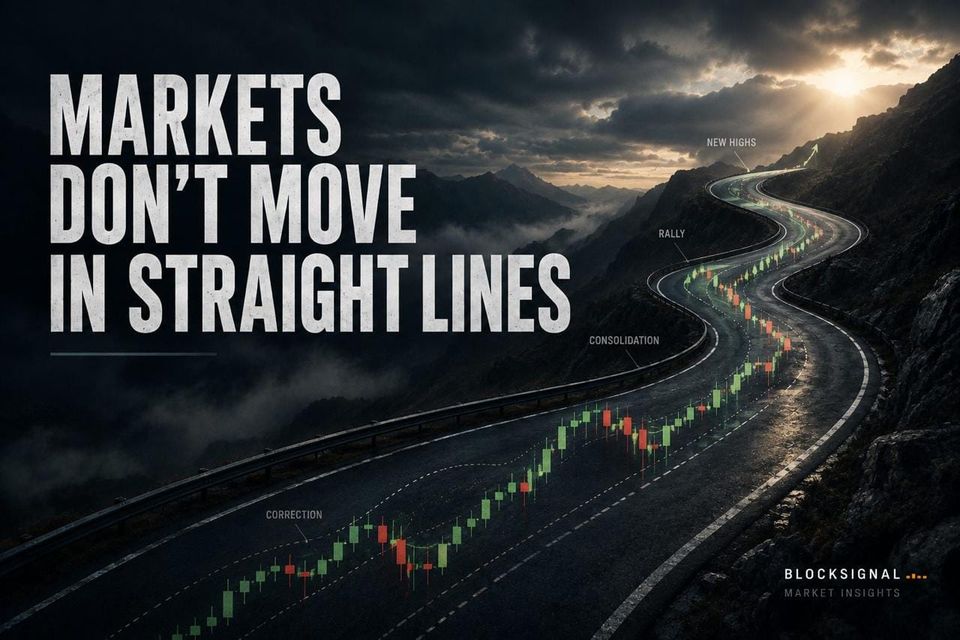
Markets don't move in straight lines
If there's one thing crypto has taught us over the years, it's that markets almost never move the way people expect them to.
Every cycle feels different while you're living through it. During strong rallies, many believe prices will continue indefinitely. During corrections, the exact opposite happens. Suddenly, timelines fill with predictions of much lower prices, recession fears, geopolitical headlines and endless reasons why the market "has to" keep falling.
Reality is usually somewhere in between.
Look back at 2021. The cycle didn't move in one clean line from the bottom to the top. Bitcoin reached a major high in spring, corrected by roughly 50% over the following months and then recovered to print new all-time highs later that year. At the time, many believed the bull market was over. In hindsight, it was simply another phase of the same cycle.
Today's market is different in many ways, but the underlying behaviour hasn't changed. Corrections still happen. Sentiment still swings from euphoria to fear within days, and new information constantly forces the market to reprice itself. A technical setup that looks perfect on Monday can become irrelevant by Friday if macro conditions change, inflation surprises the market or geopolitical tensions suddenly escalate.
That's also why we rarely look at a single indicator in isolation. A Death Cross, an overbought RSI, a Fibonacci level or even a moving average can all provide valuable context, but none of them tells the entire story. Market structure develops through the interaction of technicals, liquidity, positioning, macroeconomics and sentiment. That's why the same indicator can lead to a completely different outcome depending on the environment surrounding it.
The introduction of spot ETFs has only reinforced this. Institutional capital behaves differently from retail flows, and that changes the rhythm of the market. Instead of relying on one cycle model or expecting history to repeat itself candle for candle, it has become increasingly important to understand how liquidity is moving and where capital is willing to take risk.
For investors, this changes the conversation around portfolio management as well. The goal isn't to find one perfect entry and one perfect exit. Those rarely exist. A portfolio grows through decisions made over months, sometimes years, while adapting to new information as it becomes available. That's why we think in percentages rather than all-in entries. Keeping liquidity available isn't about trying to predict lower prices. It's about giving yourself the flexibility to react if the market offers opportunities that weren't there a week earlier.
We've seen this mindset prove valuable more than once. Whether it was the correction during the 2021 cycle, the flash crash that followed later market expansions or the recent pullback after an extended rally, periods of uncertainty often create the best opportunities to improve positioning. Not because every correction should automatically be bought, but because corrections force the market to reset expectations.
Markets don't move in straight lines. And neither do the portfolios that survive them.
If you want to follow how we position through moves like these, start by joining our free Discord community: