Is Bitcoin a Safe Haven During War?
Crypto, geopolitics and why decentralization matters
Whenever geopolitical tensions rise, global financial markets usually react in a predictable way. Investors begin reducing exposure to volatile assets and shift capital into traditional safe-haven positions such as gold, U.S. Treasuries or the U.S. dollar. Uncertainty tends to trigger a flight to safety, and historically those assets have played that role for decades.
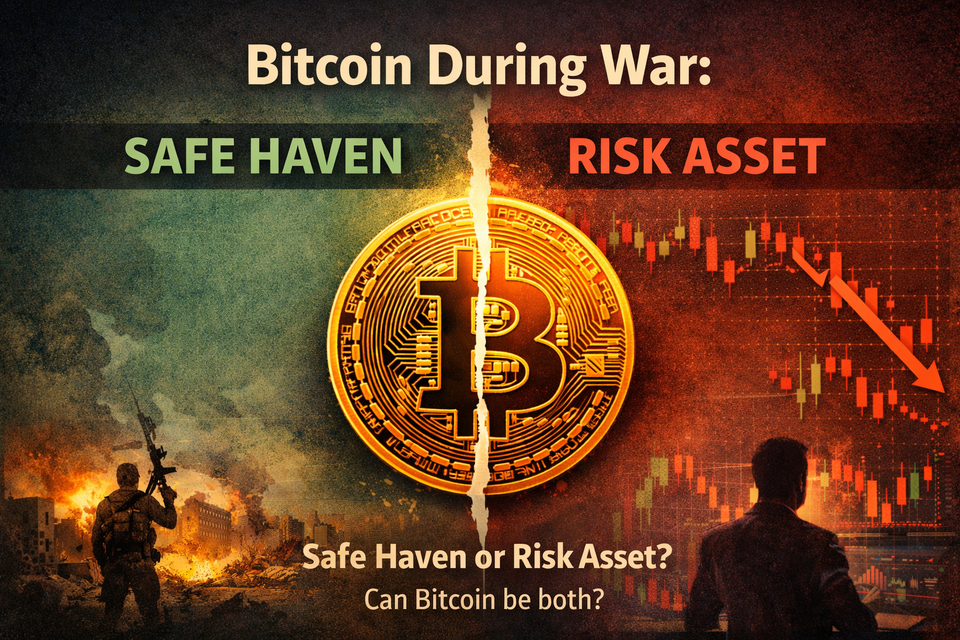
Bitcoin is often described as “digital gold.” The narrative is based on several characteristics that resemble traditional stores of value: its supply is limited to 21 million coins, it can be transferred globally within minutes and it operates on a decentralized network that does not rely on a central authority. In theory, these properties suggest that Bitcoin could serve as a safe haven during periods of geopolitical instability.
In practice, however, Bitcoin’s market behaviour is more complex.
During periods of global uncertainty, Bitcoin sometimes moves together with risk assets. This has become more visible in recent years as institutional capital has entered the market and crypto has become increasingly integrated into the broader financial system. When liquidity tightens or investors become more cautious, capital often leaves high-volatility assets first, and crypto markets can be affected by the same dynamics that influence equities and technology stocks.
At the same time, focusing only on short-term price reactions can overlook what actually makes Bitcoin fundamentally different.
The real strength of decentralized financial networks becomes visible when traditional systems stop functioning as expected. One of the clearest examples occurred during the Russia-Ukraine conflict in 2022. As parts of the Ukrainian banking system were disrupted and international transfers became more complicated, cryptocurrencies suddenly played a very practical role. Within days, millions of dollars in donations were sent globally through Bitcoin and Ethereum, helping support humanitarian aid and defense efforts when conventional financial channels were slower or restricted.
This moment highlighted something that is often overlooked in day-to-day market discussions. Bitcoin is not only a speculative asset that trades on global exchanges. It is also a decentralized network that allows value to move without relying on banks, payment providers or financial intermediaries. As long as users have access to the internet and the network remains active, transactions can continue to take place.
That property alone makes Bitcoin fundamentally different from most assets that exist purely within traditional financial infrastructure.
Because of this dual nature, the ongoing debate about whether Bitcoin is a risk asset or a safe haven may actually miss the bigger picture. Bitcoin behaves differently depending on the macroeconomic environment. In liquidity-driven market sell-offs it can move alongside risk assets. In situations where financial systems become unstable or restricted, its decentralized structure can become significantly more relevant.
Rather than forcing Bitcoin into the same categories used for traditional assets, it may be more accurate to view it as something new: a globally accessible financial network that continues to evolve as it becomes part of the broader economic system.
Understanding that distinction is often far more useful than trying to fit Bitcoin neatly into the old definitions of risk or safety.