Building a Crypto Portfolio Is More Than Picking the Right Coins
One of the easiest mistakes to make in crypto is to think that building a portfolio starts with finding the right coins.
From our perspective, that is only one part of it. The bigger question is how the portfolio is structured around different levels of volatility, how much exposure sits in Bitcoin, Ethereum and smaller altcoins, and how that structure fits the market phase.
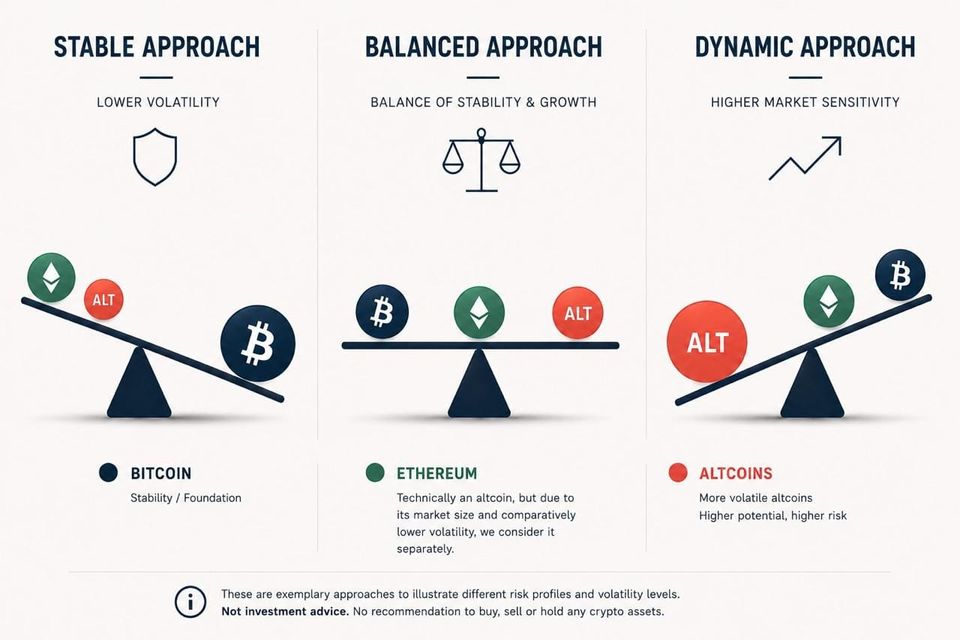
We generally look at portfolio structures across three different approaches: a more stable structure with a strong Bitcoin focus, a balanced structure with more room for Ethereum and selected altcoins, and a more dynamic structure with a significantly higher share of more volatile assets.
None of these approaches is automatically better than the others. A portfolio with less volatility can still participate strongly in a bull market, while a portfolio with more volatile assets can experience much larger moves in both directions. A higher altcoin allocation also doesn't automatically mean higher returns.
For someone who is newer to the market, a structure with lower volatility may simply be easier to understand and manage. Not because Bitcoin or lower-volatility assets are inherently better, but because the willingness to experience large drawdowns is an important part of portfolio construction. The same allocation can feel completely different to two investors depending on their time horizon, experience and tolerance for volatility.
That is also why we don't see portfolio construction as something that has to happen all at once. From our perspective, entering the market with a large position simply because prices are moving can create a completely different problem later: the position may end up being held for much longer than originally planned.
We prefer a more gradual approach. Staggered limit orders, keeping room for further entries and being willing to wait for corrections are all part of that process. A portfolio doesn't need to be fully allocated on day one.
The same applies to market analysis. Technical levels can provide a useful framework, but they don't exist in isolation. Liquidity, inflation, monetary policy, macroeconomic developments and overall market structure can change the picture surprisingly quickly. A setup that looks attractive on the chart today can look very different a few days later because the broader environment has changed.
This is also why corrections matter to us. They can change the risk profile of individual assets and create very different entry conditions from what was available during a strong rally. But waiting for a correction doesn't mean trying to predict the exact bottom. It means keeping enough flexibility in the portfolio to respond when the market gives a different opportunity.
For us, the goal is not to find the portfolio with the highest possible upside. It is to build a structure that can participate in long-term market growth while keeping enough flexibility for the periods when the market does not behave as expected.
Building a portfolio is a marathon, not a single entry.
If you want to learn more about our approach to portfolio building, risk management and market analysis, join our free Discord community: